Hydroxyapatite and fluoride are usually presented as rival answers to the same question. They are not. They do different jobs, by different mechanisms, against different problems, and the interesting question is not which one wins but whether you need both.
The short answer.
Fluoride is a decay-prevention active. It makes enamel more resistant to acid attack and helps repair early damage before it becomes a cavity. It has the largest evidence base of any ingredient in oral care.1
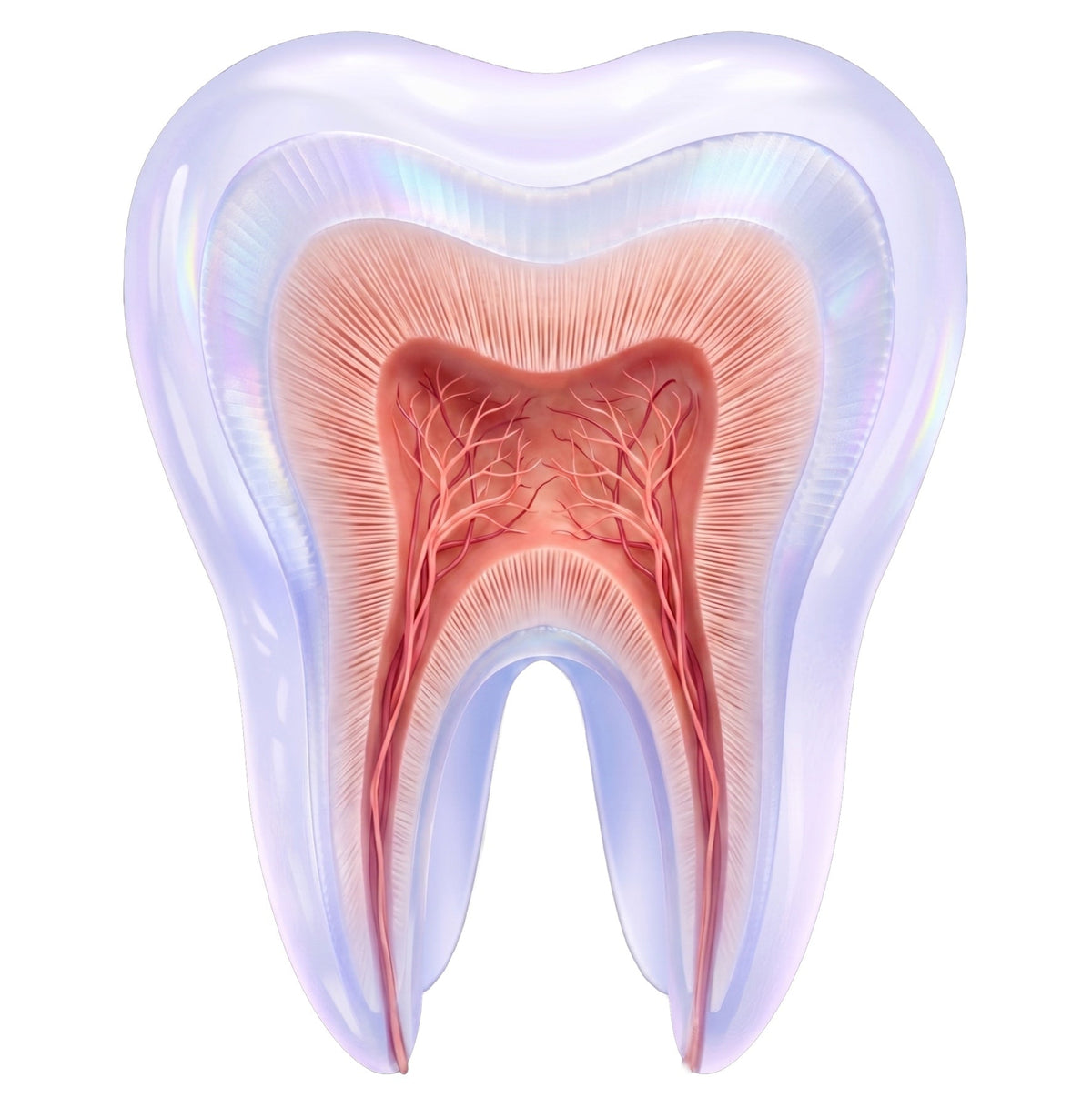
Hydroxyapatite is the mineral your enamel is actually made from. Roughly 97% of enamel is hydroxyapatite. In a toothpaste it is studied for depositing mineral back onto a worn surface, and, at nano scale, for blocking the open dentine channels that carry sensitivity to the nerve.2
They are not substitutes for each other. Fluoride does not seal dentine channels. Hydroxyapatite does not have fluoride’s evidence base for preventing cavities. A formula containing both is not hedging; it is covering two different problems.
What fluoride is, and what it does.
Fluoride is a mineral ion. When it is present in the mouth during an acid attack, it is drawn into the enamel surface alongside calcium and phosphate, forming fluorapatite, a version of the enamel mineral that dissolves at a lower pH than the original. In plain terms: it raises the threshold at which enamel starts to dissolve.
Its evidence base is unusually strong. The Cochrane review of fluoride toothpaste concentrations covers many thousands of participants and finds a clear, dose-related reduction in decay.1 Almost nothing else in a bathroom cabinet is supported like that.
What fluoride does not do is address sensitivity directly. Sensitivity is a tooth structure problem rather than a decay problem, and hardening the enamel surface does not close a channel that is already open in the dentine below it.
What hydroxyapatite is, and what it does.
Hydroxyapatite is calcium phosphate in the specific crystal form that makes up enamel and, in a less dense arrangement, dentine. Putting it in a toothpaste is a biomimetic approach: rather than making the existing mineral more acid-resistant, you supply more of the same mineral to the surface.
It comes in more than one form, and the distinction matters. Nano hydroxyapatite is milled to particles small enough to enter the dentine tubules, the microscopic channels that run towards the nerve. A systematic review and meta-analysis of nano hydroxyapatite for dentine hypersensitivity found it reduced sensitivity across the trials examined.2 A network meta-analysis comparing desensitising toothpastes placed it among the effective options.3 Biomimetic hydroxyapatite is engineered to resemble the mineral in natural enamel more closely, and is studied for laying down a mineral layer on the surface.5
A randomised trial comparing home care with a biomimetic hydroxyapatite paste against a conventional fluoridated paste found both remineralised white spot lesions.4 More recent clinical work has continued to report hydroxyapatite pastes relieving dentine hypersensitivity.6
Where the two overlap, and where they do not.
There is one genuine overlap: both are studied for remineralisation, the process of putting mineral back into a surface that acid has softened.7 They arrive at it differently, fluoride by making the existing mineral tougher and drawing calcium and phosphate back in, hydroxyapatite by supplying the mineral itself.
Outside that, they separate cleanly.
| Fluoride | Hydroxyapatite | |
|---|---|---|
| What it is | A mineral ion, delivered as sodium fluoride or sodium monofluorophosphate | The calcium phosphate mineral that enamel is made from |
| Main studied use | Preventing tooth decay | Remineralising the surface; at nano scale, occluding dentine tubules |
| How it works | Makes enamel more resistant to acid dissolution | Deposits mineral onto and into the tooth surface |
| Acts on sensitivity? | Not directly | Studied for blocking the channels that carry sensitivity |
| Evidence base for decay | Very large, including Cochrane reviews | Smaller and more recent |
| Safe to swallow in small amounts? | Yes at toothpaste doses, but children should use an age-appropriate amount | Yes; it is the same mineral as the tooth |
A summary of what each ingredient is studied for, not a ranking. Both are widely used and neither replaces professional dental care.
Can you use both?
Yes, and a growing number of formulations do. There is no chemical reason the two cannot coexist in a paste, and research looking at hydroxyapatite and fluoride together has examined exactly that combination for remineralisation.7
S3 is one of several products that carry both, and we would not claim to be the only one. What we would say is that the reasoning is straightforward. If you have sensitive teeth you have two problems at once, a nerve that is over-reacting and a surface that has worn thin, and you also still need protection from decay. Removing fluoride to make room for hydroxyapatite solves the second problem by reopening the third.
Where S3 comes in.
Alongside all three, full adult-strength fluoride as sodium monofluorophosphate. If you want the mechanism in more detail, we have written about how sensitive toothpastes work and about what dentine tubules are.
One ingredient stops the tooth dissolving. The other puts mineral back. Asking which is better is like asking whether a roof beats a wall.
Frequently asked questions.
Is hydroxyapatite better than fluoride?
Neither is better, because they are studied for different things. Fluoride has the larger evidence base for preventing tooth decay. Hydroxyapatite is the mineral enamel is made from and is studied for remineralising the surface and, at nano scale, for blocking the dentine channels that carry sensitivity. A toothpaste can contain both.
Can you use hydroxyapatite and fluoride together?
Yes. There is no chemical reason they cannot be in the same formula, and research has examined the combination for remineralisation. S3 Daily Sensitive contains nano hydroxyapatite 10%, biomimetic hydroxyapatite 5% and fluoride as sodium monofluorophosphate.
What is the difference between nano hydroxyapatite and hydroxyapatite?
Particle size. Nano hydroxyapatite is milled small enough to enter the dentine tubules, the microscopic channels that transmit sensitivity, which is why it is the form studied most for sensitivity. Larger particles remain on the surface.
Does hydroxyapatite toothpaste prevent cavities?
Research on hydroxyapatite for remineralisation and caries is growing, but the evidence base is smaller and more recent than fluoride’s. If preventing decay matters to you, the cautious choice is a toothpaste that keeps fluoride rather than one that replaces it.
Why do most hydroxyapatite toothpastes leave out fluoride?
Usually because they are built around a fluoride-free positioning rather than for a formulation reason. The two ingredients do not interfere with each other, and leaving fluoride out is a marketing decision more often than a chemical one.
Does S3 contain fluoride?
Yes. S3 Daily Sensitive contains full adult-strength fluoride as sodium monofluorophosphate, alongside nano hydroxyapatite 10%, biomimetic hydroxyapatite 5% and potassium nitrate 5%.
Both mineral technologies, plus a nerve-calming active, in one daily toothpaste. Try S3 Daily Sensitive.
This article is general information about ingredients, not dental advice. For persistent sensitivity or pain, see your dentist.