If you have read anything about sensitive teeth, you have probably met the phrase dentine tubules. It sounds technical, but it is the single clearest way to understand why a cold drink can make you wince when the person next to you does not think twice. Once you can picture them, everything about sensitivity, and everything that actually helps, starts to make sense.
What dentine tubules actually are.
A tooth is built in layers. The hard white enamel on the outside is the most mineralised material in the body. Below it sits a softer layer called dentine. Dentine is not solid. It is threaded with thousands of microscopic channels called dentine tubules, and they run inward towards the nerve at the centre of the tooth.
While enamel and gum cover them, those channels stay closed off from the outside and you feel nothing. Sensitivity begins the moment that cover is lost and the tubules are left open.
Why open tubules cause that sharp twinge.
Here is the part that surprises most people. The nerve never touches the cold drink directly. The tubules are filled with fluid, and when something cold, hot, sweet or acidic reaches their open ends, that fluid shifts inside the channels. The nerve reads the movement as a short, sharp twinge.
Cold causes the fastest and sharpest shift of all, which is why the iced coffee, the first bite of ice cream, or a lungful of winter air tends to be the moment sensitivity announces itself. This is the long accepted hydrodynamic explanation for sensitivity, first described by Martin Brännström in the 1960s.2
What opens the tubules in the first place.
Tubules become exposed when the tissue protecting them wears back. The usual reasons are enamel thinning over time, gums receding so the softer root beneath is uncovered, acid softening the surface, grinding, and sometimes recent dental work.6
You will notice what is not on that list: doing something wrong. Open tubules are rarely your fault. They are mostly what happens as teeth are used over a lifetime.
Can you close dentine tubules?
Yes, and this is the good news. Two different things genuinely help, and the best care does both at once.
The first is to calm the nerve at the end of the tubule so it stops over reacting to triggers. The second is to physically seal the open channels so the trigger cannot move the fluid inside them. The NHS is clear that a sensitivity toothpaste usually takes a few weeks of regular use to work, so consistency matters far more than any single brush.1 And if one tooth stays sharply sensitive on its own, it is worth seeing your dentist, since that can point to something other than everyday sensitivity.
Where S3 comes in.
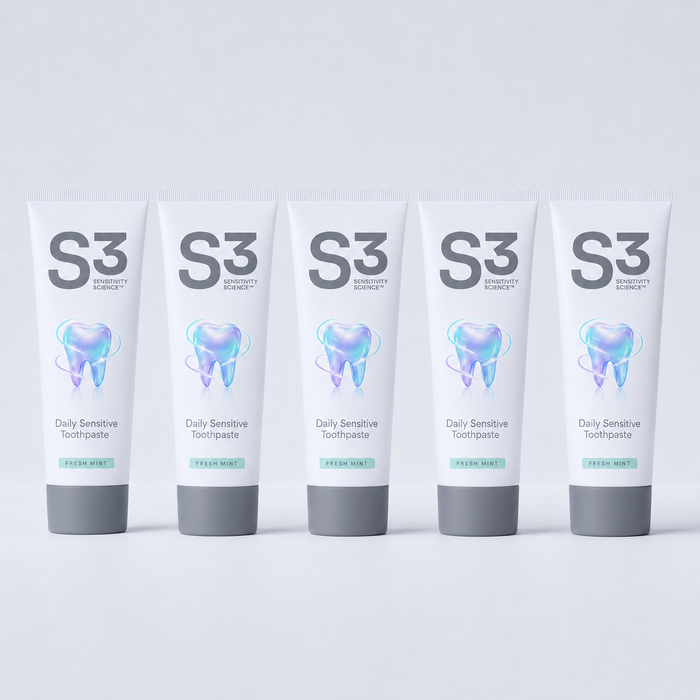
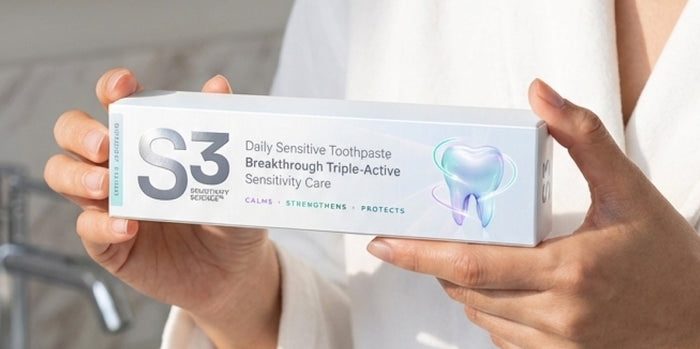
This is exactly what we built S3 Daily Sensitive Toothpaste to do, on both fronts at the same time.
Potassium nitrate, at the clinically studied 5% dose, settles the nerve at the end of the tubule so it stops over reporting pain. It is one of the most studied ingredients in sensitivity care. A Cochrane review of randomised trials found it significantly reduced sensitivity on objective measures.4
Alongside it, two forms of hydroxyapatite, the mineral your enamel is already made of, work on the channels themselves. Nano hydroxyapatite is small enough to settle into the open tubules and seal them, with up to 98% occlusion after seven days, while biomimetic hydroxyapatite lays down a fresh protective mineral layer with every brush. A 2023 review of 44 clinical trials supports hydroxyapatite for reducing sensitivity.5
When we tested the formula independently at the University of Reading, it sealed 100% of the exposed tooth surface under the microscope, compared with 84% for the market leading sensitive toothpaste.†
Calm the nerve, seal the tubule, rebuild the surface, and the cold drink has nowhere to land.
New to all this? Start with why are my teeth sensitive. Dealing with a painful flare right now? Here is how to stop sensitive teeth pain.
Frequently asked questions.
Are dentine tubules permanent?
The tubules themselves do not disappear, but the sensitivity they cause is not permanent. Open tubules can be sealed and the nerve calmed, so for most people the discomfort can be significantly reduced with consistent daily care.
Can dentine tubules be sealed at home?
Yes. Ingredients like hydroxyapatite settle into and occlude the open channels, while potassium nitrate calms the nerve behind them. The NHS notes this usually takes a few weeks of regular brushing rather than working instantly.1
How many dentine tubules are in a tooth?
Thousands run through the dentine of a single tooth, packed far too closely and far too small to see with the naked eye. It is the sheer number of open channels that makes an exposed area feel so reactive.
Why does cold hurt more than heat?
Cold causes the fastest and sharpest movement of the fluid inside the tubules, so the nerve reacts to it most quickly and most noticeably. It is why cold is usually the first trigger people notice.
† University of Reading (2026). Scanning electron micrographs of dentine specimens from the leading competitor and S3 Sensitivity Science™.