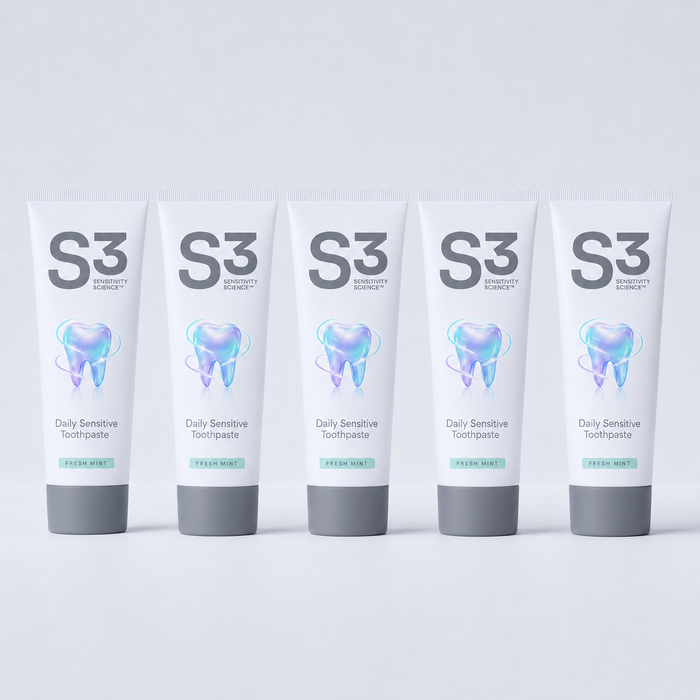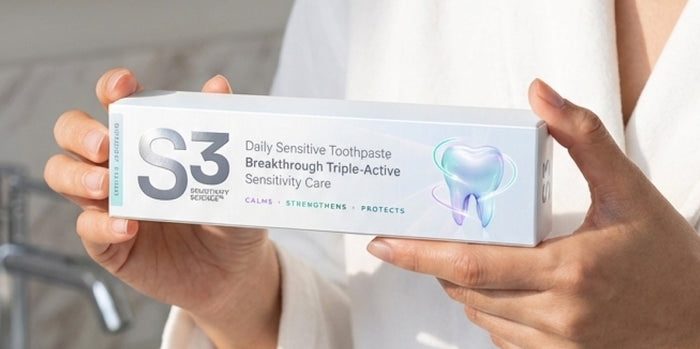
If you are reading this, you probably already own a tube of Colgate Sensitive Instant Relief. It works, up to a point, and the question is whether something else would work better. Here is an honest, side by side look, based on what each brand states about its own formula.
Key points.
- Colgate Sensitive Instant Relief is built on Pro-Argin, an arginine and calcium carbonate technology Colgate describes as plugging the dentine tubules.
- S3 Daily Sensitive combines three actives: potassium nitrate 5%, nano hydroxyapatite 10% and biomimetic hydroxyapatite 5%.
- Both contain the same fluoride compound, sodium monofluorophosphate.
- The Colgate range lists sodium lauryl sulfate. S3 is free from SLS.
- Instant Relief is a range, not one product. This page names which line it is comparing.
- This page compares ingredients and stated actions only, not clinical performance.
Which Colgate product we are comparing.
Colgate Sensitive Instant Relief is the UK name for the range built on Pro-Argin technology, sold elsewhere as Sensitive Pro-Relief. In the UK it runs across several lines, including Repair + Multi-Protection, Repair + Enamel Strength and Repair + Gentle Whitening.1
The active technology is shared across them; what changes between lines is the supporting cast. The comparison below is against the Repair + Multi-Protection line, and where the lines differ we say so. Check your own tube, because the ingredients panel is the authority and formulations change.
Why the cause matters.
Sensitivity is usually two problems wearing one name. The nerve inside the tooth is over-reacting to cold, heat and sweetness, and the layer that normally shields it has thinned or receded, leaving dentine exposed. Dentine carries microscopic channels running towards the nerve, and when those are open the trigger reaches the nerve almost directly.
You can work on either half. Blocking the channels stops the signal getting through. Calming the nerve stops it firing so readily. A formula that does one is addressing half the picture, which is not a criticism, just a description of the design choice each brand has made.
What Colgate’s approach does.
Colgate’s Pro-Argin technology combines arginine, an amino acid, with calcium carbonate. Colgate describes it as binding to the dentine surface and physically sealing the tubules with a plug of arginine, calcium carbonate and phosphate, and states that it “plugs the tubules and starts to block sensitivity pain instantly”.1
That “instantly” comes with an instruction attached, and it is worth knowing because most people never read it: Colgate’s own directions say that for instant relief you apply the paste directly to the sensitive tooth with a fingertip and massage for a minute, up to twice a day.1 The instant claim describes the finger-massage application, not ordinary brushing. If you have been brushing normally and wondering why the instant part did not happen, that is why.
The S3 approach: calm, strengthen, protect.
The difference in shape is that S3 works on the nerve and the surface at the same time, through ordinary twice-daily brushing, rather than through a separate application step. Both also carry fluoride, and, as it happens, the same one.
What to expect, and when.
Because this is the honest version of the question people actually have: switching a sensitivity toothpaste is not an overnight change, and any brand telling you otherwise is describing an application technique rather than a resolved problem.
In S3’s own consumer trial, run independently with 52 participants who were existing sensitivity-toothpaste users, 81% said their sensitivity bothered them less after one week, and at four weeks 90% reported their teeth felt less sensitive in situations that normally trigger discomfort. Those are interim results from a study still running, and they are self-reported, so treat them as a guide to the shape of the change rather than a promise about your teeth.
The practical version: give any sensitivity toothpaste a fortnight of consistent twice-daily use before judging it, and if there has been no change at all after four weeks, the problem may not be one a toothpaste solves. Our piece on how sensitive toothpastes work, and why yours might not be goes into that.
Side by side.
| Feature | S3 Daily Sensitive | Colgate Sensitive Instant Relief |
|---|---|---|
| Active ingredientsas named by each brand | Potassium nitrate 5%; nano hydroxyapatite 10%; biomimetic hydroxyapatite 5% | Pro-Argin (arginine with calcium carbonate) |
| Stated action | Calms the nerve · helps seal dentine · lays a protective mineral layer | “Plugs the tubules and starts to block sensitivity pain instantly” |
| Works on the nerve? | Yes, potassium nitrate 5% | Not stated; the stated mechanism is tubule occlusion |
| Fluoride source | Sodium monofluorophosphate | Sodium monofluorophosphate |
| Contains SLS? | No | Yes, sodium lauryl sulfate is listed |
| How it is used | Brushing twice daily | Brushing twice daily; finger application for the instant-relief claim |
| Vegan and cruelty free | Yes (stated by S3) | Not stated for this range |
| Price | £19.99 | Varies by retailer |
| Independent testing referenced | Tested at the University of Reading | “Clinically proven” (per Colgate) |
Taken from each brand’s published ingredients and product information, accessed 10 September 2026.1 Ranges and formulations change, so always check the pack you have.
The SLS difference, and who it matters to.
One difference is worth pulling out because it affects a specific group of people. The Colgate Sensitive Instant Relief lines list sodium lauryl sulfate, a foaming detergent. S3 does not.
For most people this is neutral. For people who get recurrent mouth ulcers it may not be: a systematic review found limited evidence that an SLS-free toothpaste may reduce how often ulcers appear in people who already suffer them.4 If a sore mouth is part of your picture alongside sensitive teeth, that is a real consideration rather than a marketing point. We have written about SLS-free toothpaste separately.
Arginine, potassium and hydroxyapatite: what the science says about the ingredient types.
All three are studied for dentine hypersensitivity, by different routes.
Arginine with calcium carbonate is studied for occluding the dentine tubules, forming a plug on the exposed surface. Nano hydroxyapatite, the mineral enamel is naturally made from, is also studied for occluding those tubules, and a systematic review and meta-analysis found it reduced dentine hypersensitivity across the trials examined.2 Potassium nitrate works by a different route again, with potassium ions studied for calming the nerve signal inside the tooth rather than acting on the surface. A network meta-analysis of desensitising toothpastes compared these active types against one another.3
S3 combines a nerve-calming active with two forms of hydroxyapatite. Colgate Sensitive Instant Relief uses Pro-Argin with fluoride.
The tube you already own is not the enemy. The question is only whether it is working, and whether you have given it long enough to tell.
Frequently asked questions.
Is S3 an alternative to Colgate Sensitive Instant Relief?
Both are toothpastes formulated for sensitive teeth and both contain fluoride. They use different active ingredients: S3 combines potassium nitrate with two forms of hydroxyapatite, while Colgate Sensitive Instant Relief is built around Pro-Argin. Which one suits you is a personal choice.
What is the main ingredient difference?
S3 Daily Sensitive contains potassium nitrate 5%, nano hydroxyapatite 10% and biomimetic hydroxyapatite 5%. Colgate Sensitive Instant Relief contains Pro-Argin, an arginine and calcium carbonate technology. Both contain fluoride as sodium monofluorophosphate.
Does S3 contain fluoride?
Yes. S3 Daily Sensitive contains sodium monofluorophosphate, which is the same fluoride compound used in the Colgate Sensitive Instant Relief range.
Are they free from SLS?
S3 is. The Colgate Sensitive Instant Relief lines list sodium lauryl sulfate in their ingredients. If you get recurrent mouth ulcers, that difference may matter to you.
Is S3 toothpaste vegan?
S3 states that its formulations are vegan and cruelty free. Colgate does not state this for the Sensitive Instant Relief range.
Can I switch from Colgate to S3?
Both are everyday fluoride toothpastes for sensitive teeth and are used in the same way, brushing twice daily. Give any switch a couple of weeks of consistent use before judging it. As with any change to your routine, if you have ongoing dental pain, see your dentist.
Three active ingredients in one daily toothpaste, with fluoride and free from SLS. Try S3 Daily Sensitive.
This page compares published ingredient information as stated by each brand on 10 September 2026. It is not a clinical comparison. For persistent pain, see your dentist.