If you have gone looking for an SLS-free toothpaste, something has usually prompted it: a mouth that feels raw after brushing, ulcers that keep coming back, or a dentist who suggested changing the paste before changing anything else. Here is what SLS actually is, what the research does and does not show, and how to tell whether a tube contains it.
Key points.
- SLS stands for sodium lauryl sulfate. It is a detergent, and in toothpaste its job is foam, not cleaning.
- The cleaning is done by the mild abrasives and the active ingredients. A paste can clean perfectly well without foaming much at all.
- There is limited but consistent evidence linking SLS to recurrent mouth ulcers in people who already get them. It is not evidence that SLS is harmful to everyone.
- SLS-free and fluoride-free are two entirely different things, and they get confused constantly. A paste can be one without being the other.
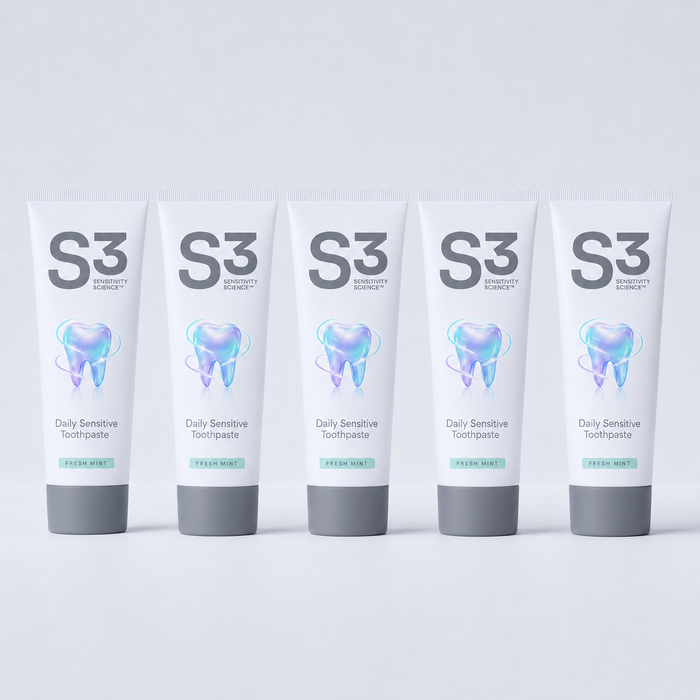
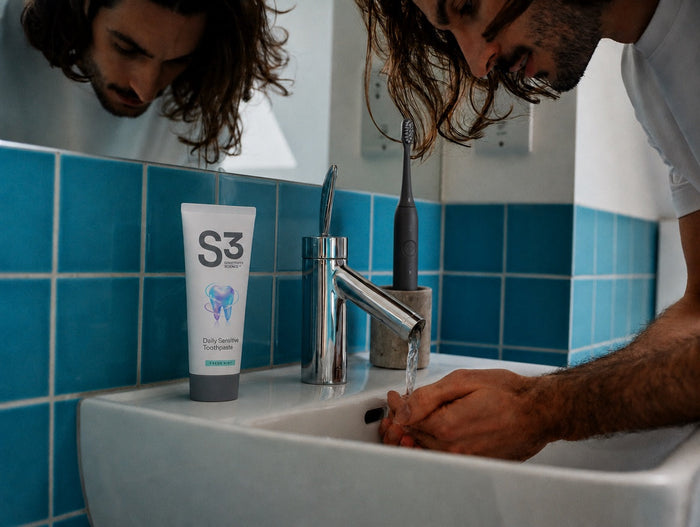
- S3 Daily Sensitive is free from SLS and keeps full adult-strength fluoride.
What SLS actually is.
Sodium lauryl sulfate is a surfactant, which is the technical word for a detergent. Surfactants lower the surface tension of water, which is what lets a liquid spread, lift oils and whip up into foam. The same class of ingredient appears in shampoo, washing-up liquid and shower gel.
On an ingredients panel it appears as Sodium Lauryl Sulfate, sometimes written the British way as sulphate. It is occasionally shortened to SLS on front-of-pack marketing, but the panel itself will spell it out.
One thing worth clearing up straight away: SLS is not the same as SLES (sodium laureth sulfate), and it is not the same as the gentler surfactants some brands use instead, such as sodium lauroyl sarcosinate or cocamidopropyl betaine. Those are different molecules with different irritancy profiles, and a paste using one of them can still describe itself, accurately, as SLS-free.
Why is it in toothpaste at all?
Mostly because of how brushing feels. Foam spreads the paste around the mouth, carries flavour, and gives the strong sensory signal that something is happening. That signal matters more than it sounds: people tend to judge whether a toothpaste is working by how it feels, and a low-foaming paste can feel like it is doing less even when it is not.
What foam does not do is clean your teeth. Plaque is removed by the mechanical action of the brush and the mild abrasive in the paste. The actives, whether that is fluoride, potassium nitrate or hydroxyapatite, do their work on the tooth surface and in the tubules underneath. None of that depends on lather.
SLS, ulcers and irritation: what the research shows.
This is the part most pages get wrong in one direction or the other, so it is worth being precise.
The interest began with a pair of small Norwegian studies in the 1990s. The first found that SLS had a desquamative effect on the lining of the mouth, meaning it loosened the outermost layer of cells.4 The second, a crossover study in people who suffered recurrent aphthous ulcers, reported fewer ulcers during the period when participants used an SLS-free paste.3 A later randomised controlled trial found the same direction of effect.2
A systematic review published in 2019 pulled the available trials together.1 Its conclusion, and the conclusion of the evidence appraisal that followed it, is best summarised as limited evidence suggests that people with recurrent mouth ulcers may benefit from an SLS-free toothpaste.5 The studies are small, several are old, and they measure people who already get ulcers.
So the honest reading is narrower than the internet version. There is no good evidence that SLS damages teeth, causes gum disease or harms people generally. There is reasonable evidence that in a subgroup of people, it makes an existing ulcer problem worse, and reasonable grounds to think a detergent that loosens surface cells is not ideal for a mouth that is already irritated. If that describes you, switching is cheap and reversible and there is no reason not to try it.
Why this matters more if your teeth are sensitive.
Sensitivity and soreness are separate problems, and they compound each other in one specific way: both make brushing unpleasant, and unpleasant brushing gets shortened.
Sensitivity itself comes from exposed dentine. Under the enamel, dentine is threaded with microscopic channels running towards the nerve, and when those channels are open, cold, heat and sweetness reach the nerve directly. We have written about what dentine tubules are in more detail. If brushing near the gumline already produces a twinge, and the paste also leaves the soft tissue raw, the natural response is to brush that area more lightly and more briefly, which allows plaque to sit exactly where the gum is already receding.
Removing one of the two irritations does not treat the sensitivity. It removes a reason to avoid the part of the mouth that most needs cleaning.
How to spot it on a pack.
Ignore the front of the tube and read the ingredients panel, which by law lists everything in the formula. Three practical rules:
- Look for the words in full. Sodium Lauryl Sulfate, or Sodium Lauryl Sulphate. Ingredients are listed in descending order of quantity, and in a foaming paste SLS usually sits in the first six or seven entries.
- Do not read “sulfate-free” as “detergent-free”. Most SLS-free pastes still contain a surfactant, just a milder one. That is a genuine difference, not a marketing trick, but it is not the same as no detergent at all.
- Check what else changed. Some SLS-free pastes drop fluoride at the same time, which is a separate decision with separate consequences. The two are not a package.
Does SLS-free mean fluoride-free?
No, and this is the single most common confusion in the category.
SLS is a detergent. Fluoride is an active ingredient with decades of evidence behind it for preventing decay.6 They do unrelated jobs and there is no formulation reason why removing one requires removing the other. The reason they so often appear together on a pack is commercial rather than chemical: brands built around a clean-label story tend to remove both at once, and shoppers reasonably conclude the two go together.
At S3 we made the opposite call, deliberately. The things worth removing from a sensitive mouth are the ones that irritate it without doing anything for it. Fluoride is not that. So S3 keeps full adult-strength fluoride, as sodium monofluorophosphate, and leaves out SLS.
Where S3 comes in.
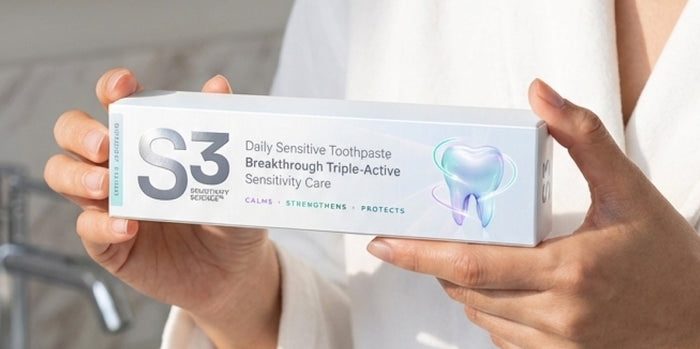
S3 Daily Sensitive is built around three active ingredients, each working on a different part of the problem, in a base that is free from SLS.
It also contains fluoride as sodium monofluorophosphate for everyday cavity protection, and it is vegan and cruelty free. If your teeth are sensitive as well as your gums, our guide to choosing a toothpaste for sensitive teeth covers what else to weigh up.
Foam was never the thing that cleaned your teeth. It was the thing that made you feel they were clean.
Frequently asked questions.
Is SLS bad for you?
Not for most people. SLS is a well-studied detergent and there is no good evidence it damages teeth or causes gum disease. The evidence that does exist concerns people who suffer recurrent mouth ulcers, where limited research suggests an SLS-free toothpaste may reduce how often ulcers appear.
Does SLS-free toothpaste clean as well?
Yes. Plaque is removed by the brush and the mild abrasive in the paste, and the active ingredients work on the tooth surface regardless of lather. What changes is the sensation: an SLS-free paste foams less, which some people take a week or two to get used to.
Is SLS-free the same as fluoride-free?
No. SLS is a detergent and fluoride is an active ingredient that helps prevent decay. They are unrelated, and a toothpaste can be free from SLS while containing full adult-strength fluoride. S3 Daily Sensitive is exactly that.
Does S3 contain SLS?
No. S3 Daily Sensitive is free from sodium lauryl sulfate. It contains potassium nitrate 5%, nano hydroxyapatite 10%, biomimetic hydroxyapatite 5% and fluoride as sodium monofluorophosphate, and it is vegan and cruelty free.
Will switching to an SLS-free toothpaste stop my mouth ulcers?
It may reduce how often they appear if you are someone who gets them repeatedly, but the evidence is limited and it is not a treatment. Ulcers that last longer than three weeks, or keep returning in the same place, should be looked at by a dentist or your GP.
How do I check whether my toothpaste contains SLS?
Read the ingredients panel on the back of the tube rather than the claims on the front, and look for Sodium Lauryl Sulfate or Sodium Lauryl Sulphate. Ingredients are listed in order of quantity, so if it is present in a foaming paste it will usually appear near the top.
Three active ingredients in one daily toothpaste, free from SLS and with full adult-strength fluoride. Try S3 Daily Sensitive.
This article is general information, not a diagnosis. If you have persistent mouth pain, ulcers lasting more than three weeks, or bleeding gums, see your dentist.