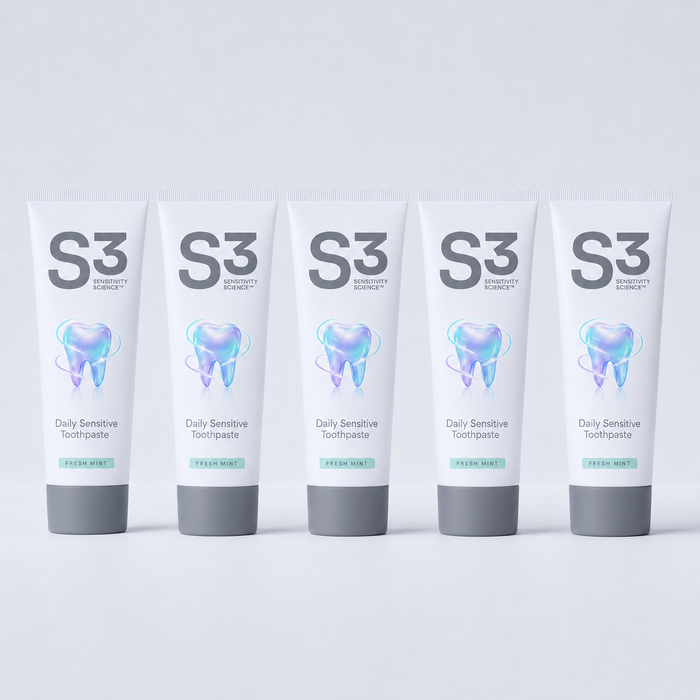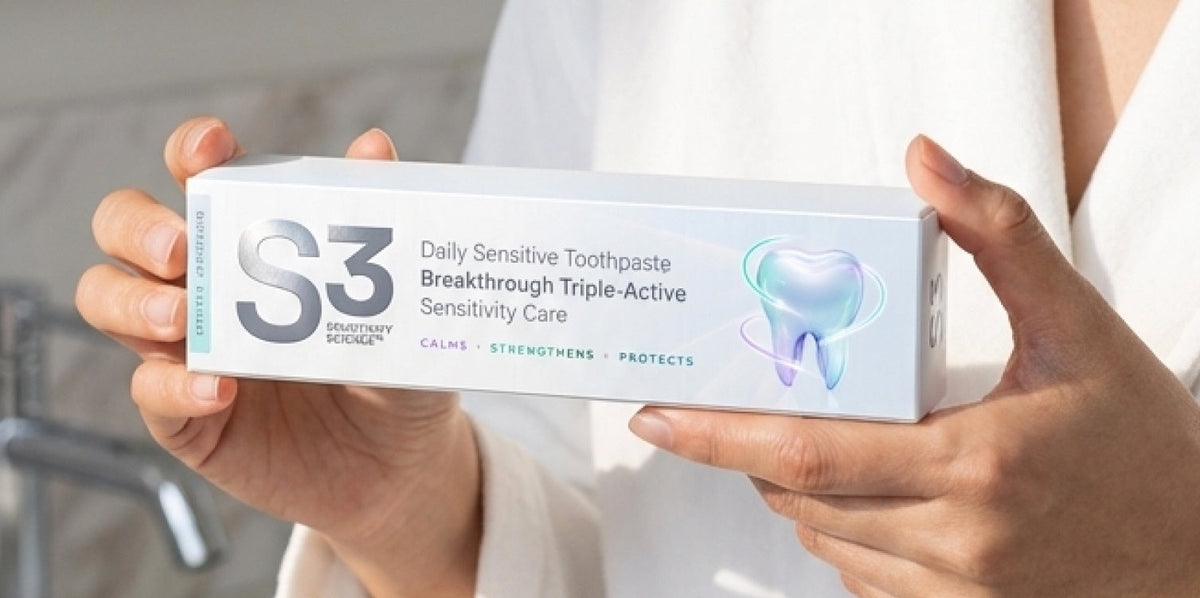
S3 Daily Sensitive and Boka are both built on hydroxyapatite, and they take opposite positions on fluoride. Here is an honest, side by side look at how they compare, based on what each brand states about its own formula.
Key points.
- Both brands use nano-hydroxyapatite. That is the genuine common ground, and it is unusual in this category.
- Boka is fluoride-free across its range, and describes itself that way. S3 keeps full adult-strength fluoride.
- Boka’s flagship paste, Ela Mint, is a general-purpose toothpaste. Boka also makes a separate sensitivity paste with 5% potassium nitrate, and it is the fairer comparison on sensitivity.
- S3 states a percentage for every active. Boka does not state an n-Ha percentage on either page.
- Both are free from SLS. Neither lists sodium lauryl sulfate.
- This page compares ingredients and stated actions only, not clinical performance.
Which Boka paste we are comparing.
Worth settling first, because Boka sells more than a dozen flavours and the answer changes depending which one you mean.
Boka’s best known product is Ela Mint Nano-Hydroxyapatite (n-Ha) Toothpaste, which the brand’s own page titles “Fluoride Free”.1 That is the paste most people mean by “Boka toothpaste”, and it is the primary comparison below.
Boka also makes Mint Coconut Cream Nano-hydroxyapatite Toothpaste for Sensitive Teeth, which Boka states is formulated with 5% potassium nitrate alongside n-Ha.2 If sensitivity is your reason for reading this, that is the product to weigh against S3, and we have included it rather than quietly comparing our sensitivity paste against someone else’s everyday one.
Why the cause matters.
Tooth sensitivity is usually two things at once. The nerve inside the tooth is over-reacting to triggers like cold, heat or sweetness, and the layer that normally shields it has worn thin or receded, leaving dentine exposed. Dentine is threaded with microscopic channels running towards the nerve, which is why an exposed patch twinges at a cold drink.
A formula can work on either half. Hydroxyapatite is studied for the surface, depositing mineral and, at nano scale, occluding those open channels. Potassium salts work on the other half, calming the nerve signal itself. Systematic review evidence supports nano-hydroxyapatite for dentine hypersensitivity,3 and a network meta-analysis of desensitising toothpastes places several active types, including potassium and hydroxyapatite, among the effective options.4
The S3 approach: calm, strengthen, protect.
S3 also contains fluoride, as sodium monofluorophosphate, for everyday cavity protection. Boka’s stated approach is nano-hydroxyapatite as the mineral active, without fluoride, described by the brand as “a biomimetic mineral form of the same material that naturally makes up 97% of your teeth”.1
The fluoride question, straight.
This is the real difference between the two brands, so it deserves a direct answer rather than a nudge.
Boka has built a range around being fluoride-free, and states it plainly. That is a legitimate position and plenty of people actively want it. If fluoride-free is what you are looking for, Boka is a well-made product from a brand that is open about its formula, and you should buy it.
S3 made the opposite call. Fluoride has the largest evidence base of any ingredient in oral care for preventing decay,5 and we did not think a sensitivity paste should ask you to give that up in order to get hydroxyapatite. The two ingredients do not interfere with each other, so we carry both. That is a difference of position, not a criticism of theirs.
Side by side.
| Feature | S3 Daily Sensitive | Boka Ela Mint | Boka Sensitive |
|---|---|---|---|
| Active ingredientsas named by each brand | Potassium nitrate 5%; nano hydroxyapatite 10%; biomimetic hydroxyapatite 5% | Nano-hydroxyapatite (percentage not stated) | Potassium nitrate 5%; nano-hydroxyapatite (percentage not stated) |
| Nerve-calming active | Yes, potassium nitrate 5% | Not stated as an active | Yes, potassium nitrate 5% |
| Contains fluoride? | Yes, sodium monofluorophosphate | No, stated fluoride-free | No, stated fluoride-free |
| Forms of hydroxyapatite | Two, nano and biomimetic | One, nano | One, nano |
| Contains SLS? | No | No, uses sodium lauroyl sarcosinate | No, uses sodium lauroyl sarcosinate |
| Vegan and cruelty free | Yes (stated by S3) | Not stated on this page | Not stated on this page |
| Price | £19.99 | Listed in US dollars; no UK storefront | Listed in US dollars; no UK storefront |
| Independent testing referenced | Tested at the University of Reading | Not stated on this page | Not stated on this page |
Taken from each brand’s published ingredients and product information, accessed 10 September 2026.12 Prices, availability and formulations change, so always check the pack.
Behind the formula.
S3 was created by a team that includes formulators who previously worked on established sensitivity brands, and it is developed with UK dentists. The formula has been tested at the University of Reading.
One practical difference worth naming: Boka is a US brand and does not operate a UK storefront, so British buyers generally reach it through third-party retailers, at whatever price and stock those carry on the day. S3 is sold in the UK in pounds.
Hydroxyapatite and potassium nitrate: what the science says about the ingredient types.
Both hydroxyapatite and potassium salts are studied for dentine hypersensitivity, and they are not interchangeable.
Hydroxyapatite is the mineral tooth enamel is naturally made from. At nano scale it is studied for its ability to occlude, or seal, the open dentinal tubules that transmit sensitivity, and a systematic review and meta-analysis found it reduced dentine hypersensitivity across the trials examined.3 Biomimetic hydroxyapatite is a form engineered to resemble natural enamel mineral more closely, and is studied for depositing a layer on the surface.
Potassium nitrate takes a different route entirely, with potassium ions studied for calming the nerve signal inside the tooth rather than acting on the surface.4
S3 combines a nerve-calming active with two forms of hydroxyapatite, plus fluoride. Boka Ela Mint uses nano-hydroxyapatite alone; Boka Sensitive adds potassium nitrate at the same 5% dose S3 uses. If you want more on the underlying mechanism, see what dentine tubules are and hydroxyapatite vs fluoride.
Two brands, one mineral, and one honest disagreement about fluoride. That is the whole comparison.
Frequently asked questions.
Is S3 an alternative to Boka?
Both are hydroxyapatite toothpastes and both are free from SLS. The main difference is fluoride: S3 contains it and Boka does not. S3 also contains potassium nitrate 5% and a second, biomimetic form of hydroxyapatite. Which suits you depends largely on where you stand on fluoride.
What is the main ingredient difference between S3 and Boka?
S3 Daily Sensitive contains potassium nitrate 5%, nano hydroxyapatite 10%, biomimetic hydroxyapatite 5% and fluoride as sodium monofluorophosphate. Boka Ela Mint contains nano-hydroxyapatite with no stated percentage and no fluoride. Boka’s separate sensitivity paste adds potassium nitrate 5%, and is also fluoride-free.
Does S3 contain fluoride?
Yes. S3 Daily Sensitive contains full adult-strength fluoride as sodium monofluorophosphate. Boka states that its toothpastes are fluoride-free.
Are S3 and Boka free from SLS?
Yes, both. Neither lists sodium lauryl sulfate in its ingredients. Boka uses sodium lauroyl sarcosinate as its surfactant, which is a different, milder detergent.
Is S3 toothpaste vegan?
S3 states that its formulations are vegan and cruelty free. Boka does not state this on the product pages referenced here, so check the current pack.
Can I switch from Boka to S3?
Both are everyday toothpastes used in the same way, brushing twice daily, so switching is straightforward. The practical change is that you would be adding fluoride and a nerve-calming active. As with any change to your routine, if you have ongoing dental pain, see your dentist.
Two forms of hydroxyapatite, a nerve-calming active and fluoride, in one daily toothpaste. Try S3 Daily Sensitive.
This page compares published ingredient information as stated by each brand on 10 September 2026. It is not a clinical comparison. For persistent pain, see your dentist.