If you have ever felt a sharp, fleeting jolt from a cold drink, a spoonful of ice cream or even a breath of winter air, you already know what tooth sensitivity feels like. The more interesting question — and the one that actually leads somewhere useful — is why it happens at all. Because once you understand what’s going on inside a sensitive tooth, the way to help it stops feeling like guesswork.
What tooth sensitivity actually is.
A tooth is built in layers. The hard, white enamel on the outside is the most mineralised material in the body, and below it sits a softer layer called dentine. Dentine is not solid. It is threaded with thousands of microscopic channels — dentinal tubules — that run inward toward the nerve at the centre of the tooth.
When enamel is intact and the gum sits where it should, those channels stay sealed off from the outside world. As the NHS describes it, sensitivity begins when that protection thins or recedes and the dentine is left exposed.1 After that, a trigger reaching the surface — cold, heat, sweetness, acid, even touch — causes the fluid inside the tubules to shift, and that tiny movement is enough to set off the nerve. This is the hydrodynamic theory, first described by Martin Brännström in the 1960s and still the accepted explanation for how sensitivity works.3 The result is that familiar short, sharp twinge. It comes fast and it usually fades fast, which is exactly how dentine sensitivity tends to behave.
That is the difference between a genuinely sensitive tooth and other kinds of dental pain. Sensitivity is a quick response to a trigger. A dull ache that lingers, throbs or arrives on its own is a different signal, and one worth showing a dentist.
Why is my tooth sensitive to cold in particular?
Cold is the trigger people notice first, and there’s a reason for that. Of all the everyday things that reach an exposed tooth, a sudden drop in temperature causes the sharpest, fastest movement of fluid inside those channels — cold draws the fluid outward most abruptly — so the nerve reacts quickly and unmistakably. It is why the iced coffee, the cold air on a winter morning or the first bite of something frozen tends to be the moment sensitivity announces itself.
For a lot of people it never escalates much beyond that. They simply adjust. They sip cold drinks more carefully, chew ice cream on the side that doesn’t complain, blow on things a little longer than they need to, quietly ditch the straw. None of it is dramatic. It is just a series of small accommodations that, added together, mean you never quite stop thinking about your teeth.
Why are my teeth sensitive? The common causes.
Sensitivity is rarely about one thing. Usually it’s a combination of factors that have, over time, left dentine exposed. The NHS and the Oral Health Foundation point to the same short list:12
- Enamel wear. Acidic food and drink, and brushing too hard or with a stiff brush, gradually thin the enamel that shields the dentine.
- Gum recession. When gums pull back — through age, firm brushing or gum disease — they expose the root surface, which has no enamel covering it at all and is especially reactive.
- Everyday grinding and clenching. Pressure over time can wear enamel and stress the tooth.
- Acidic diets. Wine, citrus, fizzy and sour foods soften enamel temporarily and, over years, contribute to wear.
- Recent dental work. A new filling, a scale and polish or whitening can leave a tooth more reactive for a short while.
You’ll notice what isn’t on that list: you. The oral-care industry has a long habit of implying that sensitivity is something you brought on yourself. We don’t see it that way. Sensitivity is common — research suggests around one in three adults experience it, and it peaks between the ages of 30 and 40, affecting women slightly more often than men.34 The more honest reading is that the products meant to help have, for years, only done half the job.
You’ll notice what isn’t on that list: you.
So why hasn’t my toothpaste fixed it?
This is the question worth sitting with. If sensitivity has a clear mechanism, why do so many people brush faithfully with a sensitivity toothpaste and still flinch at the cold?
Because most sensitivity toothpastes tackle one part of the picture. Some contain an ingredient that calms the nerve, so it reacts less. Others lay down a layer that helps block the exposed channels. Both approaches help. Neither, on its own, addresses the fact that a sensitive tooth has a calming problem and a structural one at the same time. Calm the nerve but leave the enamel thin, and the channels stay open. Cover the surface but ignore the nerve, and it still over-reacts. Single-active solutions leave a gap, and that gap is where the lingering sensitivity lives.
What genuinely helps.
The answer follows from the cause. If a sensitive tooth has more than one thing going wrong, the daily care it needs has to do more than one thing.
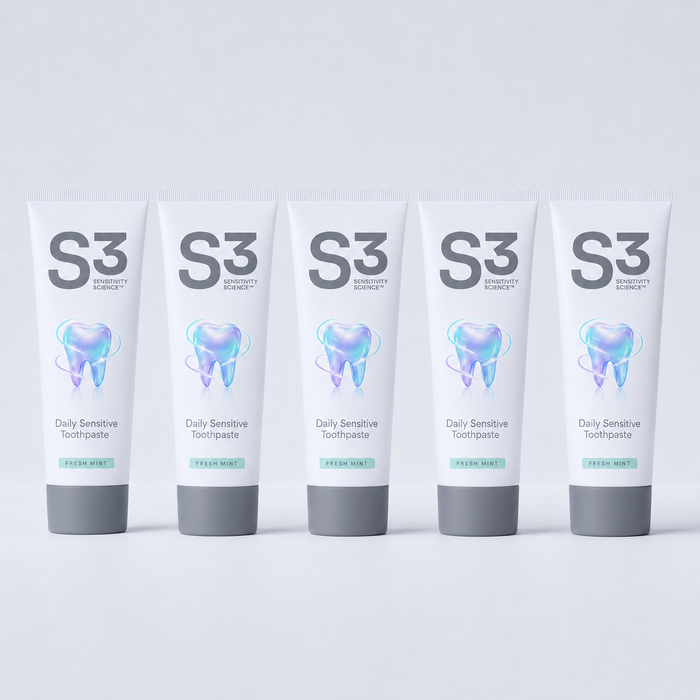
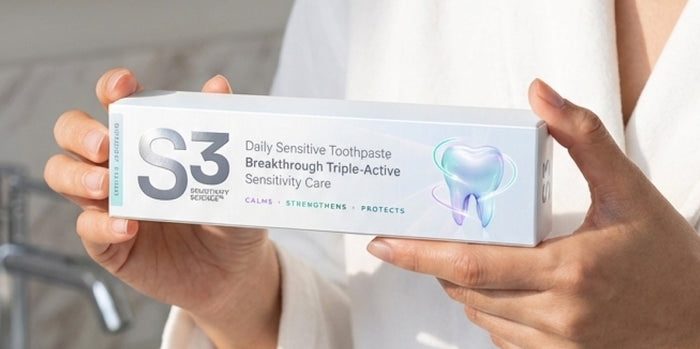
That conviction is what S3 Daily Sensitive Toothpaste is built on. Our triple-active S3 Repair Technology™ (patent-pending) is designed to deliver the three actions sensitive teeth need, together: calm, strengthen and protect. Potassium nitrate at the clinically proven 5% dose helps quiet the nerve’s response to triggers — a mechanism confirmed by a Cochrane review of randomised trials.5 Nano-hydroxyapatite and biomimetic hydroxyapatite — enamel-like crystals small enough to settle into those pinhole-sized openings — help occlude the exposed channels, rebuild strength at the enamel surface and remineralise it, forming a protective mineral layer over it; a 2023 systematic review of 44 trials supports hydroxyapatite’s role in reducing sensitivity.6 Fluoride works alongside it for its established protection against decay. Used consistently, it is designed to treat sensitivity as the whole problem it actually is.
In S3’s own consumer testing, 87% of people saw an improvement within seven days, with the active working at the enamel surface within two minutes. Understanding why your teeth are sensitive is the first step. The second is choosing a daily routine that answers all of it, not part of it.
Caught in a flare-up right now? Here’s how to stop sensitive teeth pain. Ready to choose? Read the best toothpaste for sensitive teeth.
Frequently asked questions.
Why are my teeth suddenly sensitive?
A relatively sudden onset often follows enamel wear reaching a tipping point, a stretch of acidic eating and drinking, gum recession exposing a root, or recent dental work. If sensitivity appears abruptly in one tooth and stays, the NHS advises seeing a dentist to rule out a crack or decay.1
Why is my tooth sensitive to cold but nothing else?
Cold causes the fastest, sharpest movement of fluid inside the exposed channels in dentine, so it tends to be the first and most noticeable trigger.3 Many people are reactive to cold well before sweet, hot or acidic triggers register.
Is tooth sensitivity permanent?
Not usually. Everyday dentine sensitivity can be helped considerably with consistent daily care that calms the nerve and strengthens the enamel surface. Persistent sensitivity in a single tooth should be assessed by a dentist.