Enamel does not grow back. That single fact is why enamel erosion gets talked about in slightly ominous terms, and why so much of the advice around it stops at what not to eat. It is true as far as it goes, but it is only half the story. Enamel is lost as mineral, and mineral is something a tooth surface can take back in.
What tooth enamel erosion actually is.
Enamel is the hard outer shell of the tooth, and it is the most mineralised material the body makes. Roughly 96 per cent of it is a crystal called hydroxyapatite, packed into rods so densely that it can survive a lifetime of chewing.
Erosion is what happens when acid dissolves that crystal. Acid lowers the pH at the tooth surface, the mineral starts to go into solution, and the enamel softens. The Oral Health Foundation describes dental erosion as the gradual loss of enamel caused by acid attack, distinct from decay, which is driven by the acid that plaque bacteria produce.12
The word that matters here is gradual. A single acidic drink does not strip a tooth. It softens the surface for a while, and saliva then does what saliva is for, buffering the acid and returning calcium and phosphate to the enamel. Erosion is what happens when that cycle tips, when acid arrives more often than the surface can recover from, over months and years.
Why erosion and sensitivity travel together.
Underneath the enamel sits dentine, a softer layer threaded with thousands of microscopic channels called dentinal tubules. Those channels run inward towards the nerve. While the enamel is thick and intact, they stay sealed off from the outside world.
As enamel thins, that seal weakens. A trigger reaching the surface, cold most obviously, but also sweetness, heat or acid, moves the fluid inside the tubules, and the nerve reads that movement as pain. It is the reason erosion so often announces itself not as a visible change but as a twinge in a cold drink. Dentine hypersensitivity is common, affecting somewhere around one in three adults depending on how it is measured, and worn enamel is one of the routes into it.7
What actually causes it.
Erosion is almost always a pattern rather than a single culprit. The usual contributors:
- Acidic food and drink. Citrus, wine, vinegar, fruit juice, fizzy drinks including the sugar-free ones, and sports drinks. Frequency matters more than quantity, so sipping something acidic across an afternoon is harder on enamel than drinking it in one go.
- Reflux and frequent vomiting. Stomach acid is considerably stronger than anything in a diet, and reflux, morning sickness or an eating disorder can erode the inner surfaces of the teeth in particular. This is worth raising with a doctor as well as a dentist.
- Brushing at the wrong moment. Enamel is softest immediately after an acid attack, so brushing straight after something acidic scrubs at a surface that has not yet rehardened.
- A dry mouth. Saliva is the body's own buffer. Medication, dehydration and some medical conditions reduce it, and less saliva means less recovery between acid attacks.
- Grinding and clenching. Not erosion in the strict sense, but mechanical wear compounds it, and the two rarely travel alone.
You will notice what is not on that list: any suggestion that this is a personal failing. It is important to identify and address the cause of the erosion, and seek advice from a dentist, to ensure no further enamel is being eroded. However, after the cause has been remedied, it is important to ask if and how mineral can be put back into the teeth.
Can enamel be rebuilt?
Here is where the flat answer of no does the subject a disservice. Enamel cannot regrow, because the cells that made it are gone once a tooth has erupted. But enamel loss is mineral loss, and mineral can be redeposited into a softened surface. That process is remineralisation, and it happens naturally every day through saliva.
What daily care can do is tilt the balance. Fluoride has decades of evidence behind it for hardening enamel against acid and preventing decay, and it works by helping form a more acid-resistant mineral at the surface.3 More recently, hydroxyapatite has been studied for the same job from a different angle: rather than changing the mineral, it supplies the mineral, in a form chemically close to what enamel is already made of.
Studies using nano-hydroxyapatite have shown it depositing into softened enamel and into the exposed dentine surface, rebuilding mineral content and smoothing the surface.4 Work on biomimetic hydroxyapatite has reported a similar effect, with the particles forming a mineral layer over the enamel surface.5 Research combining hydroxyapatite with fluoride has looked at whether the two work alongside each other rather than in competition.6
Enamel cannot regrow. Mineral can go back in. Those are not the same sentence, and the difference is the whole of what daily care can do.
What to change, practically.
- Wait before brushing. Leave an hour after anything acidic. Rinsing with water, or with plain milk, helps the surface recover sooner.
- Group acidic things with meals. Saliva flow is highest at mealtimes, so the same glass of juice does less damage alongside food than on its own mid-afternoon.
- Use a straw for acidic drinks. It keeps the liquid away from the front teeth, which are usually the first to show wear.
- Brush gently, with a soft brush. Pressure does not clean better, and on a thinned surface it costs more than it gains. The NHS advice on brushing is worth reading if it has been a while.3
- Spit, do not rinse. Rinsing with water straight after brushing washes away the active ingredients you have just applied.
Where S3 comes in.
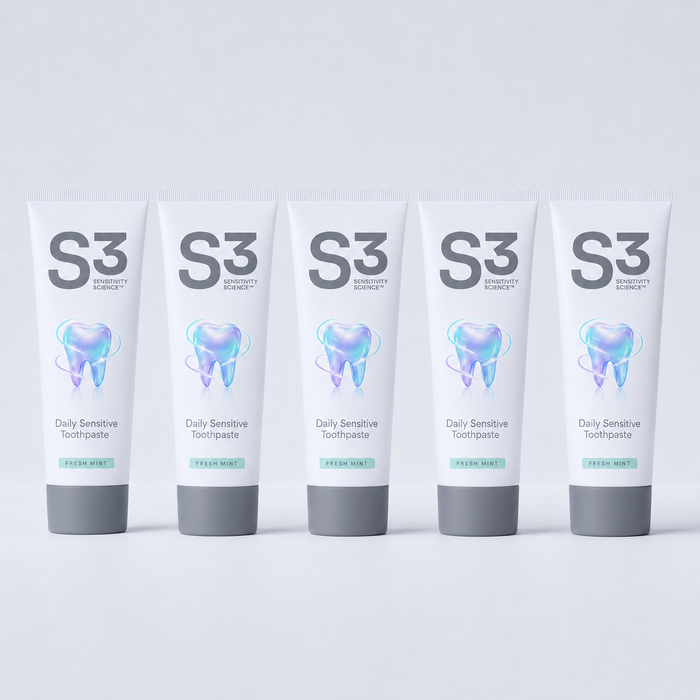
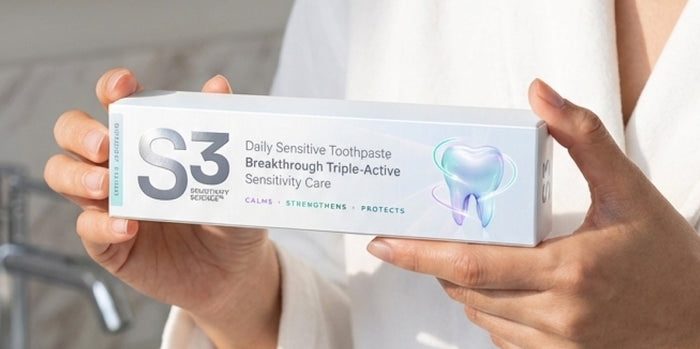
S3 Sensitivity Science™ was built on the view that a worn, sensitive tooth has more than one thing going wrong with it, so daily care has to do more than one thing. Our patent-pending S3 Repair Technology™ is a triple-active blend designed to calm the nerve, strengthen the enamel surface and protect what is there, at the same time, alongside full adult-strength 1450 ppm fluoride for decay protection.
In S3's own consumer testing, 88 per cent of people said they felt less sensitive using it. Erosion is slow, and so is the answer to it: the point of a daily paste is that the small gains compound.
Read more about S3 Daily Sensitive Toothpaste, or start with why teeth become sensitive in the first place.
Frequently asked questions.
Can enamel erosion be reversed?
Lost enamel does not grow back, because the cells that formed it are gone once the tooth has erupted. Softened enamel can take mineral back in, though, and that is what remineralisation means. Daily care that supplies mineral to the surface can strengthen what remains, but it cannot replace enamel that has already worn through.
How do I know if I have enamel erosion?
Common signs are teeth that look more yellow as the darker dentine shows through, edges that appear translucent or slightly see-through, and sensitivity to cold or sweet things. Only a dentist can tell erosion from other kinds of wear, so it is worth having it looked at rather than diagnosed in the mirror.
Is enamel erosion the same as tooth decay?
No. Erosion is enamel dissolved by acid from food, drink or the stomach. Decay is driven by acid produced by plaque bacteria feeding on sugar, and it creates a cavity rather than a general thinning. The two can happen at once, and both are worth a dentist's opinion.