Almost everyone who whitens their teeth gets some sensitivity. It is the single most common side effect of the treatment, it is usually temporary, and it is not a sign that something has gone wrong. Knowing roughly how long it should last, and what genuinely shortens it, takes most of the worry out of the fortnight after.
Why whitening makes teeth sensitive.
Whitening works by peroxide. Hydrogen peroxide, or carbamide peroxide which breaks down into it, passes through the enamel and into the dentine underneath, where it breaks apart the coloured molecules that have built up over years of coffee, tea and red wine.
The point worth understanding is that the peroxide has to travel through the tooth to do that. It moves through the enamel and into the dentinal tubules, the microscopic channels that run inward towards the nerve. On its way it irritates the nerve, which responds exactly as it responds to cold: with a sharp, short signal. That is the twinge.
So whitening sensitivity is not damage. It is a temporary inflammatory response to something passing through a route that is normally closed to the outside world. It also explains the pattern people report, sharp zingers that arrive out of nowhere in the days after treatment, rather than a constant ache.
How long it lasts.
For most people the answer is days rather than weeks. Sensitivity typically peaks in the first day or two after a treatment, then fades steadily. By two weeks it has usually gone entirely.
Three things push it towards the longer end. Higher-concentration gel, as used in a single in-chair session, tends to produce sharper sensitivity than the lower-concentration trays worn over a fortnight. Whitening repeatedly without a break gives the tooth no recovery time. And a tooth that was already sensitive before whitening, through worn enamel or gum recession, starts from a lower threshold and takes longer to come back.
What is not normal is sensitivity that is still meaningfully there after a month, pain that lingers long after the trigger, or one tooth that is markedly worse than the rest. Any of those is worth telling your dentist about, because whitening can also reveal a crack or a leaking filling that was already there.
Have it done properly, and legally.
This is worth being blunt about. In the UK, tooth whitening is a dental procedure. It is legal only when carried out by a dentist, or by a dental hygienist or therapist on a dentist's prescription, and only for people aged 18 or over.12
Whitening offered in a beauty salon, or by anyone not registered with the General Dental Council, is illegal. The concern is not only the regulatory one. An untrained operator is more likely to leak gel onto the gums, use an unsuitable concentration, or whiten a tooth that needed a filling first, and each of those turns a fortnight of mild sensitivity into something worse. A dentist also checks if the teeth are healthy enough to whiten in the first place.
What actually settles it.
The evidence here is more useful than the folklore, and most of it points the same way: prepare the tooth before, and support it after.
- Start a desensitising paste before you whiten, not after. This is the one that surprises people. Potassium nitrate applied before bleaching has been studied specifically for reducing the sensitivity that follows, and starting a week or two ahead gives the active time to work.3
- Keep using it through and after treatment. Potassium works by calming the nerve's response rather than by blocking the channel, and a Cochrane review examined potassium-containing toothpastes for dentine hypersensitivity.7
- Consider a hydroxyapatite paste alongside. Nano-hydroxyapatite has been studied for post-bleaching sensitivity, where the mineral deposits into the exposed surface.4 It has also been trialled inside the bleaching gel itself and as a pre-treatment before whitening.56
- Space the sessions out. If you are using trays, taking a night off between wears usually costs very little in the final result and a great deal in comfort.
- Avoid extremes of temperature for a few days. Not because they cause harm, but because the tooth is primed to react and there is no need to provoke it.
- Go easy on acidic food and drink for 48 hours. The surface is more permeable straight after treatment, and acid does not help.
The best time to treat whitening sensitivity is the fortnight before you whiten.
Where S3 comes in.
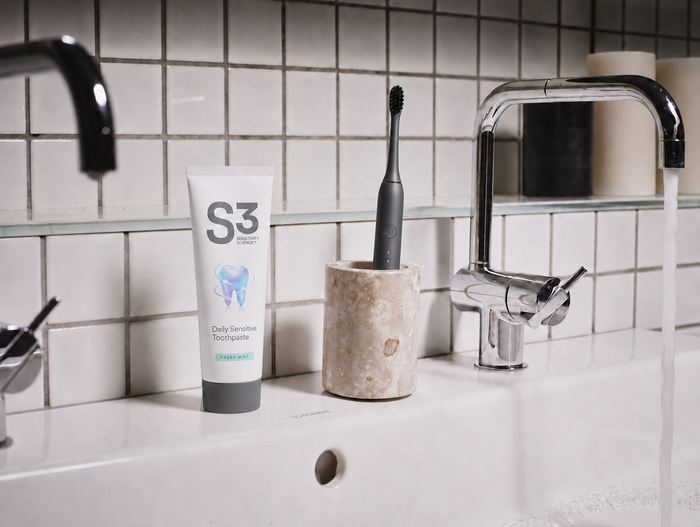
S3 Sensitivity Science™ is built around the idea that a sensitive tooth has a calming problem and a structural one at the same time, which is precisely the state a freshly whitened tooth is in. Our patent-pending S3 Repair Technology™ combines potassium nitrate with two forms of hydroxyapatite, alongside full adult-strength 1450 ppm fluoride.
In S3's own consumer testing, 88 per cent of people said they felt less sensitive using it. If you have whitening booked, starting a fortnight before is the version of this advice that pays for itself.
See S3 Daily Sensitive Toothpaste, or read more on why teeth become sensitive.
Frequently asked questions.
How long does sensitivity after teeth whitening last?
Usually a few days. It tends to peak in the first 24 to 48 hours after treatment and fade steadily from there, and for most people it has settled completely within two weeks. Higher-concentration in-chair treatments and repeated sessions without a break both push it towards the longer end.
How can I stop my teeth from being sensitive after whitening?
Start a desensitising toothpaste one to two weeks before you whiten rather than waiting until afterwards, and keep using it through and after treatment. Space tray sessions out, avoid very hot and very cold things for a few days, and go easy on acidic food and drink for the first 48 hours.
Should I stop whitening if my teeth are sensitive?
Mild, short-lived sensitivity is expected and is not a reason to stop, though taking a night off between tray sessions usually helps a lot. Stop and speak to your dentist if the pain lingers well after the trigger, wakes you at night, is concentrated in one tooth, or if the gums are sore or blanched.